Special Investigation

I Bought 19 Pillows In 6 Years. All Of Them Failed. Then A Chiropractor Showed Me The 5,000-Year-Old Mistake We've All Been Making.

She spent $2,300 on pillows that flattened, stunk, or made the pain worse. Then a skeleton in a chiropractor's office revealed why every single one was engineered to fail her—and what ancient Egyptians figured out 50 centuries ago.


✓ Fact-Checked by Dr. Elena Torres, DPT — Board-Certified Physical Therapist
Pillow graveyard

My "pillow graveyard." Six years and $2,300 worth of broken promises.

May 4th, 2026. 6:14 AM.

I woke up and couldn't lift my head off the pillow.

Not "stiff neck, give it a minute." Not "slept wrong, it'll loosen up."

My neck was locked. Frozen. Like someone had poured cement into the base of my skull while I slept.

I lay there, staring at the ceiling, doing the math I'd been avoiding for years.

Hand on neck

Every morning started the same way: a hand on my neck, testing how bad it was today.

19 pillows. Six years. $2,300. Down pillows. Memory foam blocks. Shredded foam. A $130 Tempur-Pedic they wouldn't let me return. A water pillow that leaked. A contour pillow that felt like sleeping on a cinder block. One that smelled so bad my eyes watered for three days.

All of them in my basement now. A graveyard of failed promises.

My husband brought me coffee and two Advil. He didn't ask what was wrong. He already knew. This was Tuesday. This was every day.

"Maybe it's just—" he started.

"Don't say it."

"—getting older."

I'm 46. I run a marketing team. I'm not old. But I moved like my mother. I groaned getting out of bed. I couldn't turn my head to check my blind spot without a jolt of pain shooting from my neck into my shoulder blade. My mornings started with 20 minutes of stretching just to function like a normal person.

That morning, lying frozen in bed, I made a decision.

Not "I'll try one more pillow." I was done with that. I'd been saying that since pillow number six.

I decided to find out why every pillow I'd ever owned had failed me. Not which pillow was "best." WHY. What was actually wrong. What the pillow industry wasn't telling me.

What I found changed everything.

· · ·

It Wasn't "Just A Sore Neck." It Was Eating My Life.

My name is Rachel. I live outside Philadelphia. I manage a team of 14 people, I have two kids under 10, and for the last six years, chronic neck pain has been the first thing I feel every morning and the last thing I think about every night.

It started the way it starts for everyone. A little stiffness at 40. "Probably slept wrong." "Probably stress." "Probably need a new mattress."

By 42, the stiffness turned into daily headaches that sat right at the base of my skull like a clamp. By 44, I had numbness in my fingers three mornings a week. By 46, I was organizing my entire life around the pain:

No more driving at night—I couldn't turn my head fast enough. No more picking up my daughter. No more sleeping in the same position for more than an hour without waking up to re-adjust.

I was 46 and I felt 70.

Daughter watching

My daughter learned not to ask me to pick her up. She just stopped asking.

"I had a collection of pillows in my closet, trying to find the right one to help my neck pain. It's truly a horrible road we are walking." — Amazon reviewer describing the exact cycle I was trapped in

And the worst part? I was trying. Nobody could accuse me of not trying.

The $2,300 Pillow Graveyard

Here is every dollar I spent trying to fix this problem before I understood what was actually causing it:

What I TriedCost
Down & feather pillows (4) — went flat in weeks$180
Generic memory foam pillows (5) — chemical smell, too hot$225
Shredded foam "adjustable" pillow — lumpy, needed constant re-fluffing$79
Tempur-Pedic Neck Pillow — $130, non-returnable, too rigid$130
Water pillow — heavy, leaked, made pain worse$65
Contour pillows from Amazon (6) — wrong height, "cinder block"$240
Cooling gel pillow — cracked, cover slid off$55
Cervical rolls, wedges, inserts$120
Chiropractor visits (2x/month, 3 years)$4,320
Massage therapy (monthly, 2 years)$1,920
OTC painkillers, muscle relaxers, CBD$480
Total wasted on temporary relief$7,814

The chiropractor adjustments felt incredible—for about 48 hours. Then I'd sleep on my pillow and undo everything. The massage therapist told me my traps were "the tightest she'd ever felt." The Advil took the edge off but never touched the source.

The basement graveyard

The basement graveyard. Down. Memory foam. Shredded foam. Water. Cooling gel. Every type, every price point. None of them worked.

I wasn't treating the cause. I was managing the symptom.

And every night, for 8 hours, the actual cause was sitting right under my head.

· · ·

What The Chiropractor Showed Me On A Skeleton Changed Everything I Believed About Pillows

Three days after the frozen-neck morning, I was sitting in my chiropractor's office. Not for an adjustment. I told her I didn't want one.

"I want you to show me why this keeps happening," I said. "Not fix it for two days. Show me what's actually wrong."

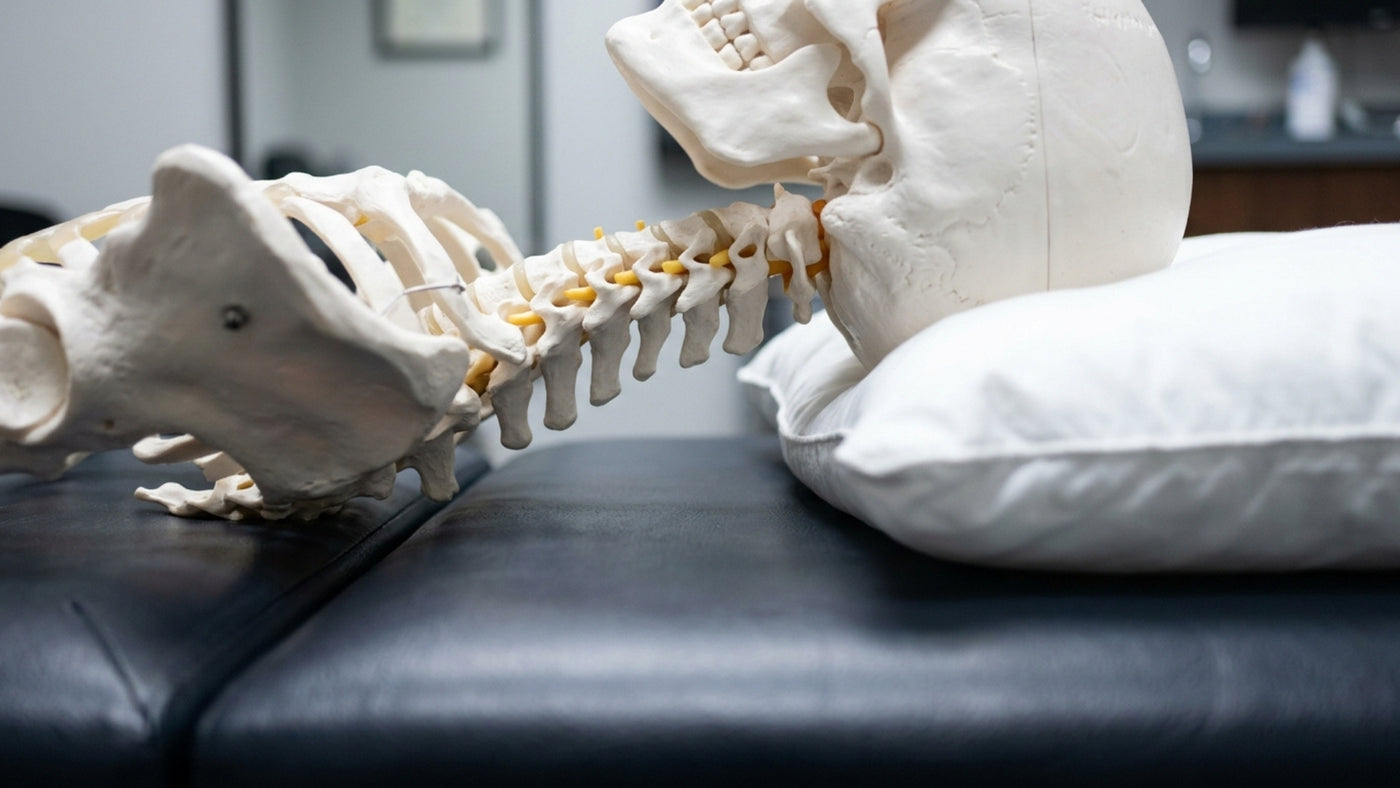
She pulled out a spine model. Laid it flat on the exam table. Then she grabbed a regular pillow—a standard, soft, department-store pillow—and put it under the skull.

"See this?" She pointed to the neck. "See the gap? Your neck is floating. Completely unsupported. Your cervical spine has a natural curve—the lordotic curve—and this pillow is doing absolutely nothing to maintain it."

I stared at the gap between the pillow and the skeleton's neck. I'd never noticed it before. But it was obvious once she pointed it out.

Anatomical spine model

The gap I'd been ignoring for six years. Every flat pillow leaves your neck floating in mid-air.

"Every flat pillow is designed to cushion your head," she said. "But your head doesn't need cushioning. It's a ball on a stick. What needs support is the NECK—the seven cervical vertebrae, the curve, the gap between your shoulder and your ear."

She pressed down on the skeleton's head. The neck collapsed into the pillow. No support. No structure. Nothing holding the spine in alignment.

"This is what happens every night," she said. "For eight hours. Your neck muscles work a full shift trying to stabilize your spine because your pillow isn't doing the job. You wake up and those muscles are exhausted, inflamed, and tight. I adjust you, they relax for a day. Then you go back to sleep on that pillow and we start over."

"I'm not failing to fix you, Rachel. Your pillow is undoing my work every single night."

I felt something crack open in my chest. Not anger. Relief.

For six years I'd quietly believed the problem was my body. That I was built wrong. That I was too picky. That maybe this was just what 46 felt like.

It wasn't me. It was the pillow. It was every pillow. The entire design was wrong.

· · ·

Then She Showed Me Something That Made Me Feel Like An Idiot—In The Best Way

My chiropractor pulled out her phone. She showed me a picture from a museum.

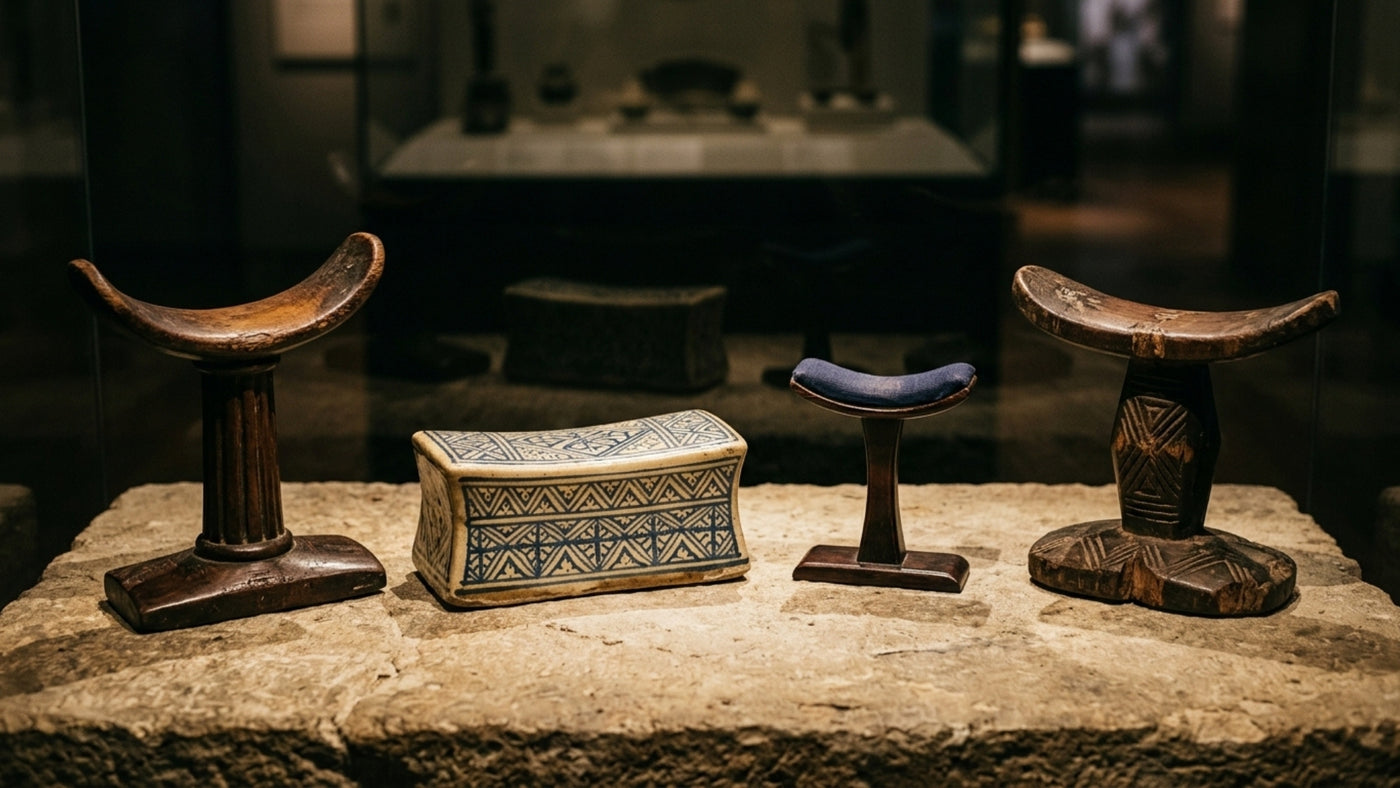
It was an Egyptian headrest. Carved wood. Curved top. A single column raising the head off the bed surface. Dated to roughly 2000 BC.

"Look at the shape," she said. "What does it support?"

"The neck," I said. "Not the head."

"Exactly. For 5,000 years, Egyptians slept on contoured neck supports. So did the Japanese—they had wooden neck cradles called takamakura. Chinese emperors slept on porcelain pillows shaped to support the cervical curve. Some African cultures still use wooden headrests today."

She swiped to another photo. A traditional headrest from Kenya. Same principle. Curved. Supporting the neck. Elevating the head.

Ancient neck supports

From left: Egyptian weres headrest (~2000 BC), Chinese porcelain pillow (Tang Dynasty), Japanese takamakura, traditional African neck rest. Same principle. Five thousand years.

"Every civilization on earth understood this," she said. "Support the neck. Let the head float. Then, in the 20th century, America invented the soft flat pillow—a bag of feathers that cushions the head and lets the neck dangle. And we've been waking up sore ever since."

The Insight That Changed Everything For Me

The problem wasn't that I bought bad pillows. The problem was that the entire modern pillow category was engineered around the wrong body part. Every flat pillow—cheap or expensive, foam or feather—cushions the HEAD and ignores the NECK. Ancient civilizations did the exact opposite. They were right. We were wrong. For 80 years.

I sat in that office feeling a strange mix of frustration and hope. Frustration because the answer had been sitting in museums for five millennia. Hope because if the problem was structural—a design flaw, not a body flaw—then a structural solution could fix it.

"So I need a contour pillow," I said. "I've tried six of those. They all failed too."

She shook her head. "You tried single-height contour pillows. And that's the other half of the problem."

· · ·

"You're Not A Side Sleeper Or A Back Sleeper. You're Both. And That's Why One-Height Pillows Fail You By 3 AM."

My chiropractor stood up and demonstrated something I'd never thought about.

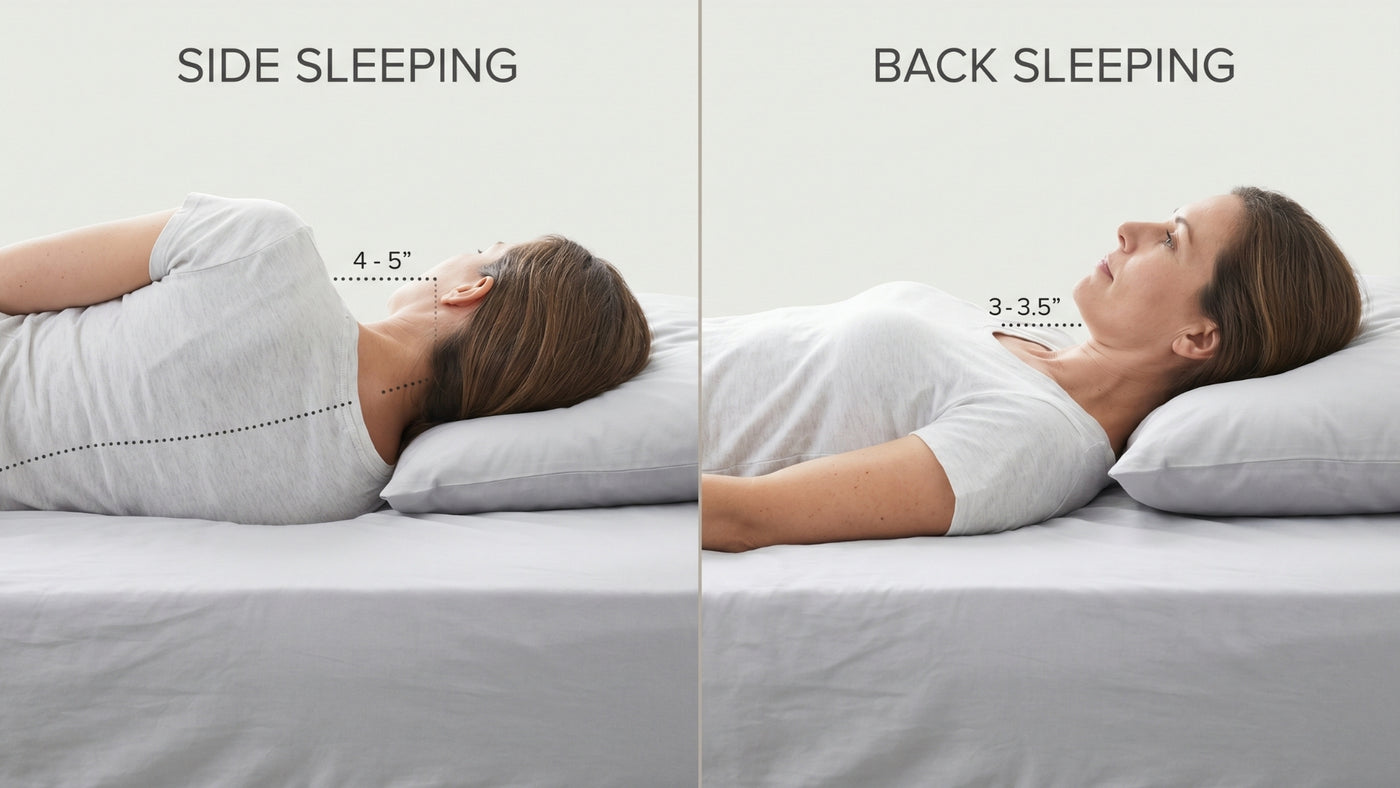
She lay on her side on the exam table. "When you're on your side, there's a gap between your shoulder and your ear. About four to five inches, depending on your frame. The pillow needs to fill that gap to keep your spine straight."

Then she rolled onto her back. "When you're on your back, that gap disappears. Your head is closer to the surface. You only need about three inches of height to maintain the cervical curve. If the pillow is still five inches high, it's pushing your chin into your chest. Flexing your neck forward. Creating pressure instead of relieving it."

Side vs back sleeping diagram

Side sleeping needs ~4.7" of height. Back sleeping needs ~3.5". A single-height pillow is always wrong for half your night.

She sat up and looked at me.

"You told me you're a combination sleeper. You start on your side and roll onto your back around 2 or 3 AM."

"Every night," I said.

"So every pillow you've ever owned has been the right height for ONE position and the wrong height for the other. Half your night, it works. The other half, it's making things worse. And you wake up at 3 AM and can't figure out why you're suddenly uncomfortable."

"I sleep like a rotisserie chicken, so this pillow is perfect—it has two bumps on either side, so no matter if I'm on my back or roll to one side, the pillow is thicker in those spots." — Amazon reviewer describing the exact solution I didn't know existed

I thought about every contour pillow I'd returned. Every one had been a single height. Too high for my back. Too low for my side. I'd blamed the foam. I'd blamed the firmness. I'd blamed my body.

The problem was geometry. And the answer was embarrassingly simple.

"What I need," I said slowly, "is a pillow with two different heights. High side for when I'm on my side. Low side for when I roll onto my back."

She smiled. "Now you're getting it."

"Does that exist?"

"It does. And it's built on the same engineering principle that pharaohs used 5,000 years ago—just rebuilt in memory foam instead of carved wood."

· · ·

What She Showed Me Next—And What Happened On Night One

My chiropractor opened her desk drawer and pulled out a pillow I'd never seen before.

It didn't look like a normal pillow. Two contoured ridges at different heights. A concave depression in the center. It looked almost medical.

"This is the pillow I sleep on," she said. "And the pillow I've started recommending to patients who keep coming back because their adjustments won't hold."

I took it from her. It was heavier than I expected. The foam was dense—slow-rebound, not the cheap stuff that squishes flat. I pressed my thumb into it and watched it recover, slowly, like it was remembering its own shape.

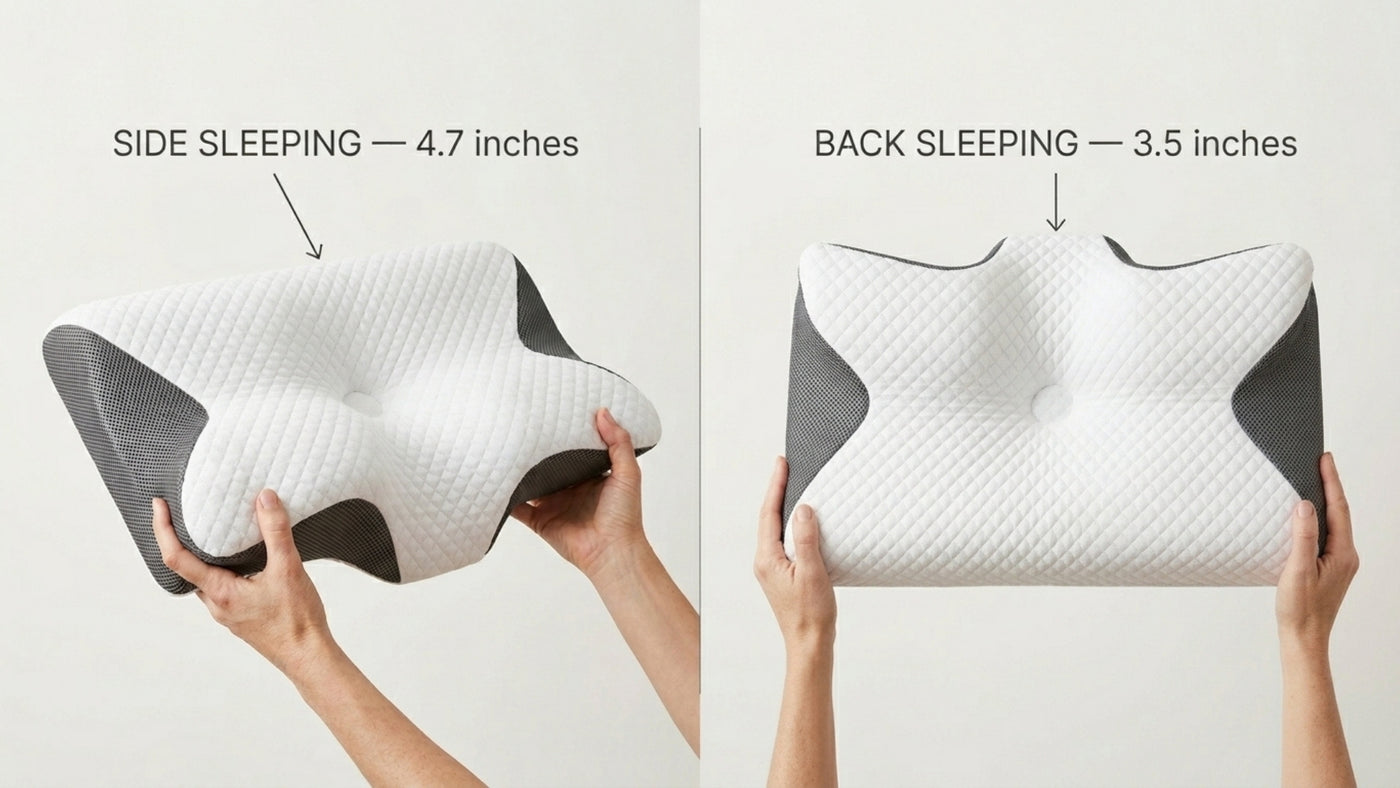
"High side is for side sleeping," she said, pointing to the taller ridge. "Low side is for back sleeping. When you roll over in the middle of the night, you flip it. Or just rotate your head to the other side. Two heights. Both positions. One pillow."

Pillow rotation showing both heights

High side. Low side. Flip it. The mechanism is so simple it's almost embarrassing — which is exactly why it works.

I looked at her. "I've spent $2,300 on pillows. I've tried 19 of them. Why is this one going to be different?"

She pointed at the skeleton on the table. At the gap under the neck. At the headrest photo still glowing on her phone screen.

"Because this is the first pillow you'll own that was designed to support your neck instead of cushion your head. And it's the first one with two heights, so it won't betray you at 3 AM when you roll over."

I took it home that night.

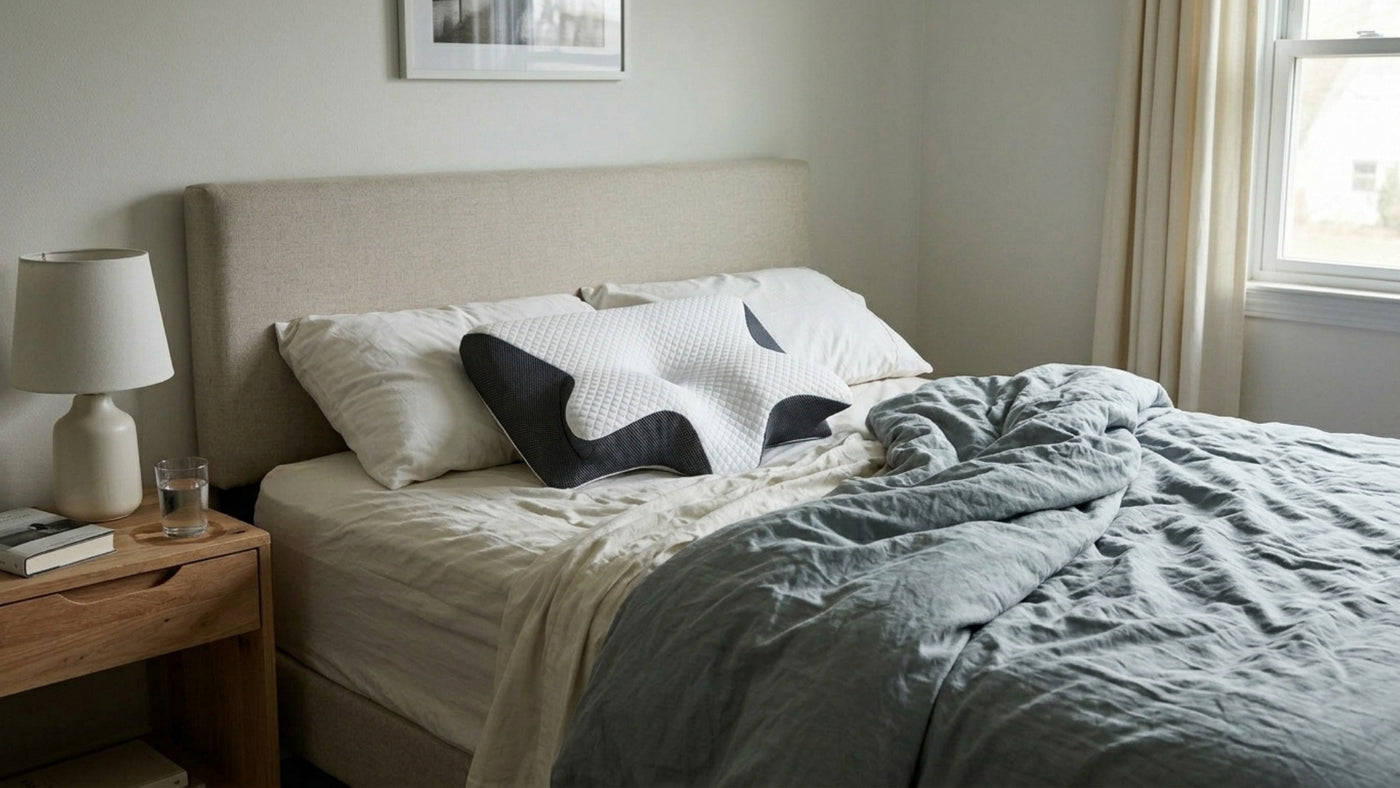
Pillow on bed

It looked strange on my bed. My husband called it "the alien pillow." I didn't care.

What happened the next morning is the reason I'm writing this.

· · ·

The First Morning I Didn't Reach For My Neck

That first night, I lay down on the high side. I'm a side sleeper first. The ridge filled the gap between my shoulder and my ear. My neck wasn't floating. It wasn't straining. It was just… held.

Sometime around 3 AM, I rolled onto my back. Half asleep, I shifted my head to the low side of the pillow. The lower contour cradled the curve of my neck without pushing my chin forward.

I didn't wake up. Not fully. For the first time in years, the position change didn't jolt me awake.

The alarm went off at 6:30.

I opened my eyes. And before I was even conscious of what I was doing, I noticed something was missing.

My hand wasn't on my neck.

For six years, the first thing I did every morning—before opening my eyes, before thinking, before anything—was reach for my neck. Bracing. Testing. How bad is it today?

That morning, my hand was on my pillow. My neck didn't hurt. There was no grinding when I turned left. No ice-pick when I turned right.

I sat up. Swung my legs over the side of the bed. Stood up.

No stretching. No Advil. No twenty-minute warm-up just to function.

Kitchen morning, coffee in hand

The first morning I didn't reach for my neck. Six years of bracing — gone in one night.

I stood in my kitchen and started crying into my coffee.

My husband walked in. "What happened?"

"Nothing," I said. "Nothing happened. That's the point."

· · ·

My 30-Day Sleep Diary

I kept notes because I didn't trust it. Nineteen pillows had trained me not to. Here's what actually happened:

Night 1
Slept through until the alarm. First time in months. Woke up without reaching for my neck. The foam smelled faintly when I first unboxed it—gone by morning. Not the eye-watering chemical attack I got from the ZAMAT. Just a faint "new foam" scent that vanished in 24 hours.
Day 3
Backed out of the driveway and checked my blind spot without thinking about it. No pain. No grinding. I actually gasped. My daughter asked if I'd seen a spider.
Day 7
Skipped the chiropractor for the first time in three years. Not because I was testing anything. I just… forgot. My neck didn't remind me to go.
Day 14
The headaches stopped. Not "got better." Stopped. The base-of-skull clamp that had been my constant companion for four years—gone. I stopped keeping Advil in my desk drawer.
Day 21
Picked up my 7-year-old daughter. Full lift. She said, "Mommy, you haven't done that in forever." She's right. I hadn't. I couldn't. Now I can.
Day 30
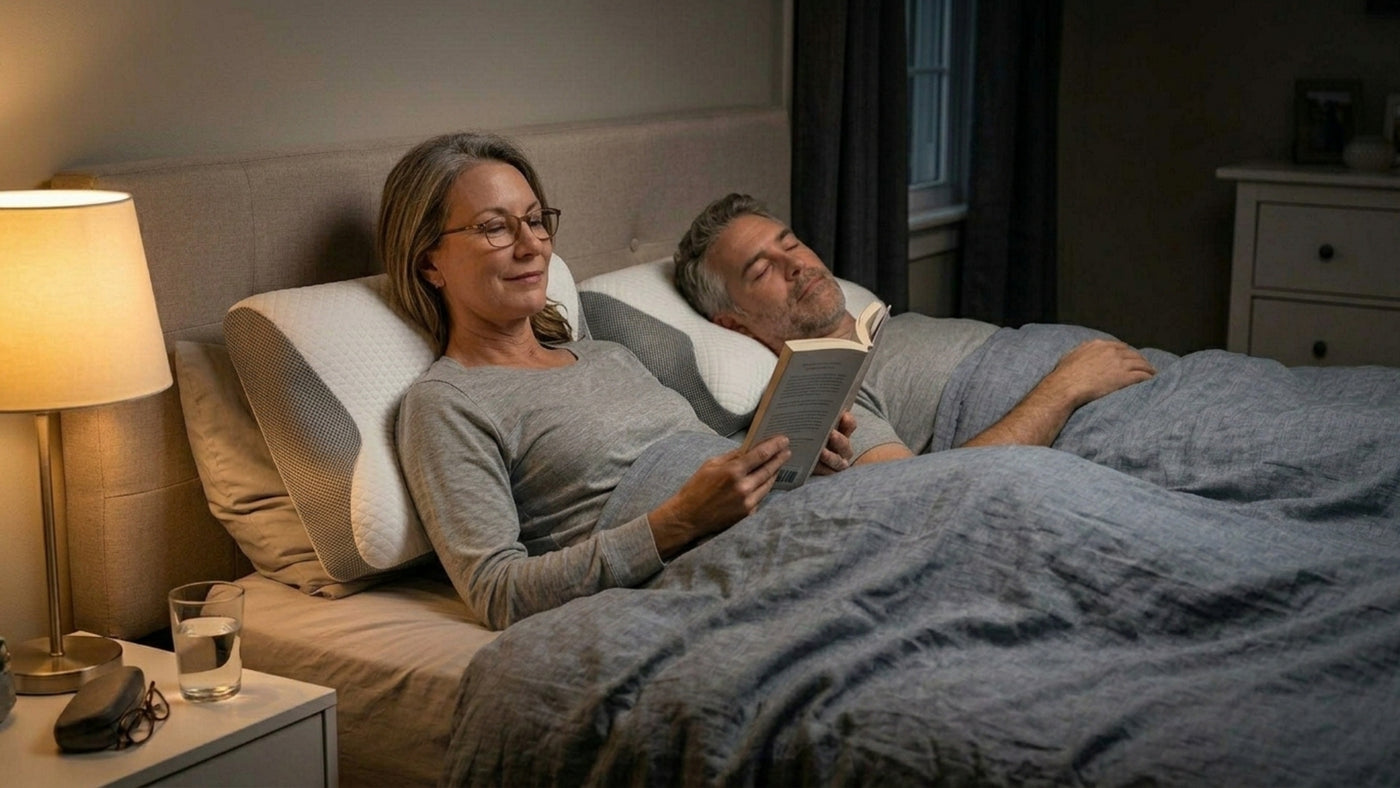
My husband came into the bedroom and watched me reading. "You look different," he said. I asked what he meant. "You're not propped up on three pillows with a heating pad. You're just… lying there. Like a normal person." He paused. "I missed that."
Woman reading in bed

Day 30. One pillow. No pain. No heating pad. No fortress of props. Just… normal.

· · ·

Why This Pillow Worked When 19 Others Failed

I went back to my chiropractor after 30 days. Not for an adjustment—for an explanation. I needed to understand why this one worked.

She broke it down into four things no other pillow I'd owned had done simultaneously:

1. The dual-height contour. The high side (about 4.7 inches) fills the shoulder-to-ear gap for side sleeping. The low side (about 3.5 inches) cradles the cervical curve for back sleeping. Flip or rotate. Both positions supported. No compromise.

2. The concave head cradle. The center of the pillow dips inward. Your skull settles into it and stays stable. Your head isn't sliding off a flat surface all night. It's cradled—which means your neck muscles can actually shut off.

3. The neck-first engineering. The raised ridges sit UNDER your neck, not under your head. This is the ancient principle—Egyptian headrests, Japanese takamakura, Chinese porcelain pillows—rebuilt in slow-rebound memory foam. Support the neck. Let the head float.

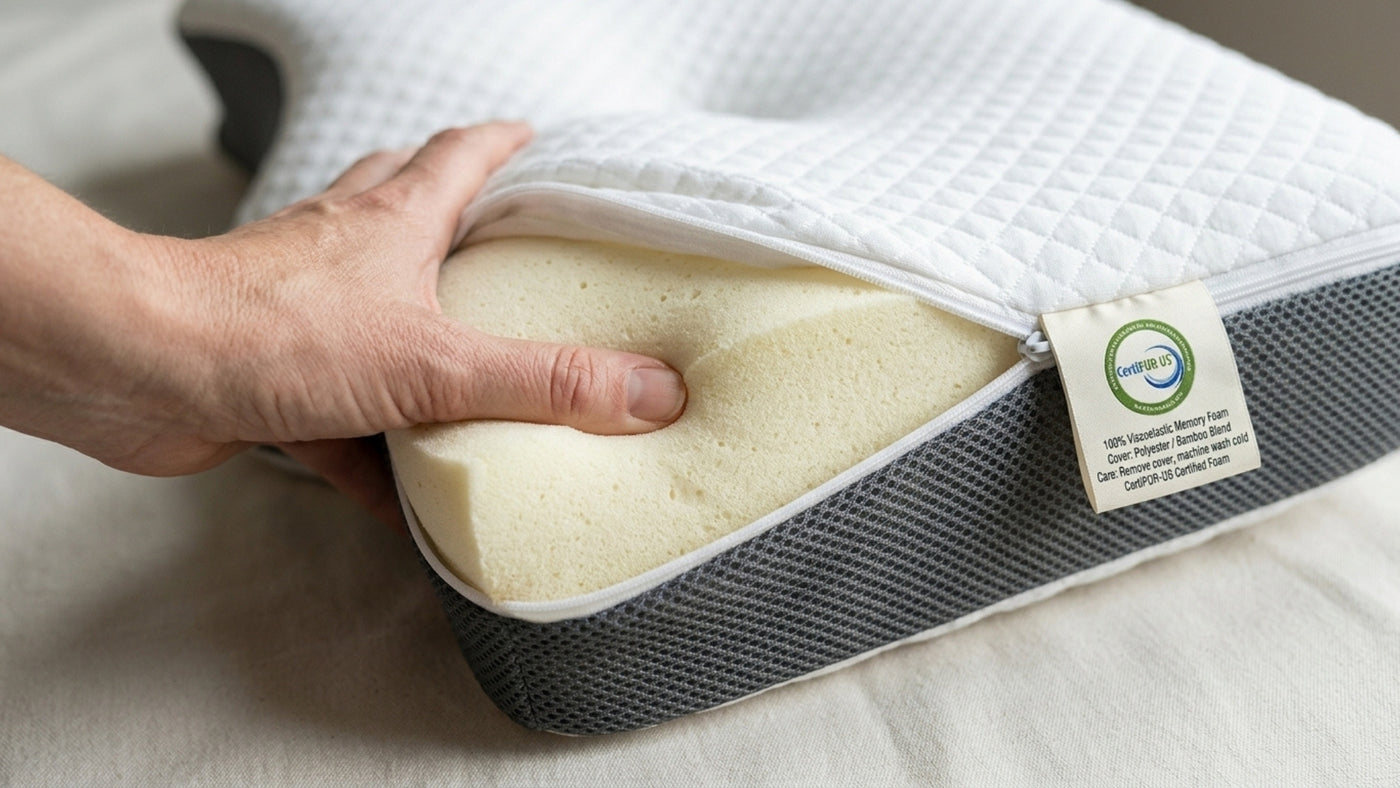
4. The foam doesn't flatten. High-density, CertiPUR-US certified viscoelastic foam. Not the cheap stuff that collapses in five months. Four months in, mine looks exactly the same as the day I took it out of the box. I press my thumb in, it recovers in about three seconds. Every time.

↕️
Dual-Height
Contour
🛡️
CertiPUR-US
Certified Foam
❄️
Cooling
Breathable Cover
🔄
Side + Back
Sleeper Design
About The Smell — Let Me Be Honest

When I first unboxed this pillow, there was a faint foam scent. Not the "eyes watering, had to put it in my cabin outside" nightmare I got from one Amazon pillow. Just a slight new-material smell that was gone within a day. The foam is CertiPUR-US certified—tested for formaldehyde, phthalates, mercury, and heavy metals. I'm telling you this because every other pillow brand either ignores the smell issue or lies about it. This one was honest. And honestly? It was barely noticeable.

CertiPUR-US badge

CertiPUR-US certified means the foam was independently tested for harmful chemicals — not a brand claim, a verifiable third-party stamp.

· · ·

I'm Not The Only One This Pillow Saved

After I started telling people about this pillow, I went looking for others who'd had the same experience. What I found in the reviews stopped me cold. These are real people describing exactly what I went through:

★★★★★
"I have spent a unbelievable amount of money on pillows made from any and all materials on the market and I was just done shopping for pillows. This pillow has 2 height on each side & the small side fit my measurements preferably, it placed my neck inline with my spine giving me alignment and I have not had a headache, neck ache since I been sleeping on this pillow!"
Amazon Reviewer
✓ Verified Purchase
★★★★★
"This thing saved my life. I was uncomfortable every day. Now I'm back to normal… this pillow basically cured me. Give it a shot."
Amazon Reviewer — via TODAY.com
✓ Verified Purchase
★★★★★
"I'll be 70 years old in April. I now have the neck of a youngster again! No Headaches and I can turn my head from right to left, with no pain or stiffness."
Verified Customer
✓ Verified Purchase
★★★★★
"I sleep on all sides so this pillow works. I use the low hump for side/stomach sleeping and the high hump for back sleeping."
Amazon Reviewer
✓ Verified Purchase
★★★★★
"It's so much better than living on muscle relaxants and pain relievers!"
Amazon Reviewer
✓ Verified Purchase
· · ·

Why I'll Never Go Back To "Normal" Pillows

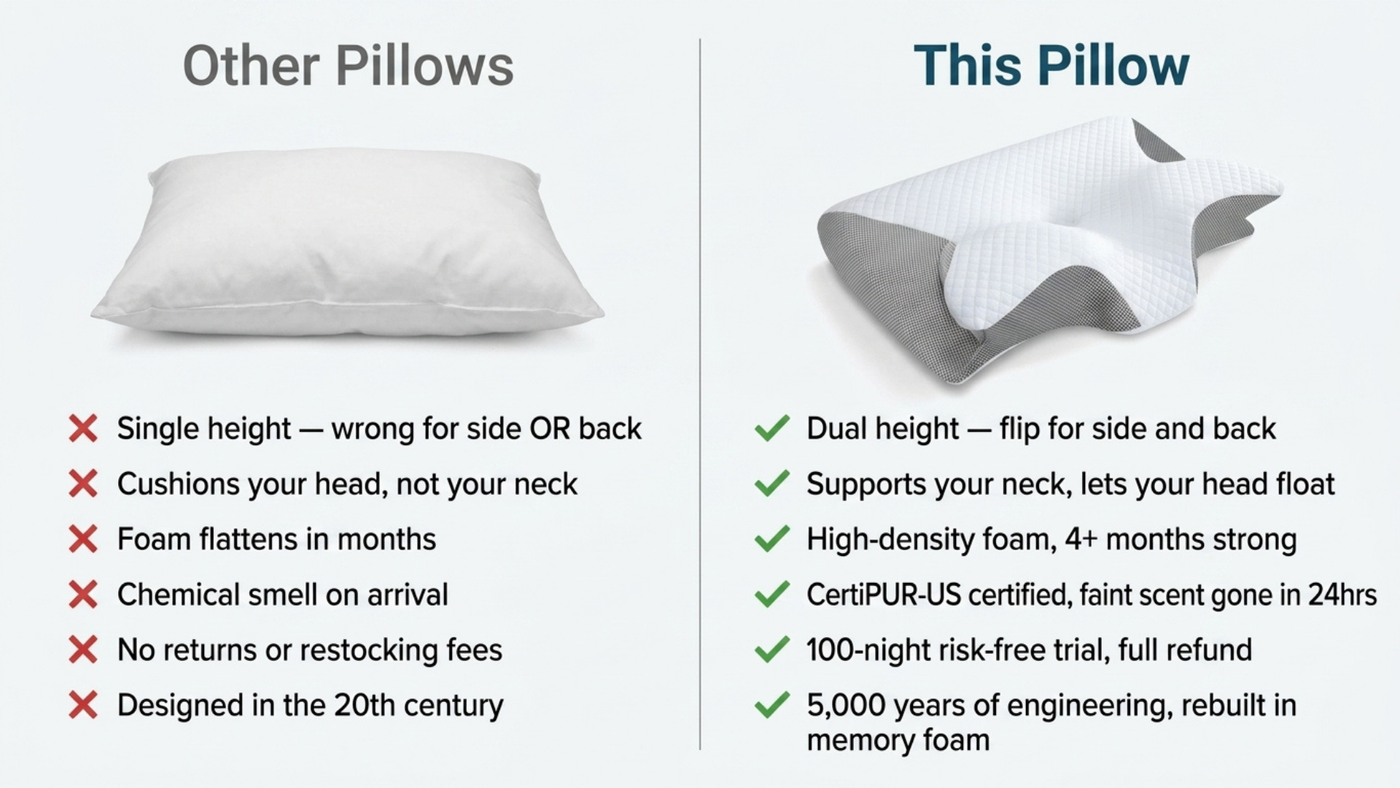
To make sure I wasn't imagining things, I compared this pillow against every alternative I'd tried:

Other Pillows This Pillow
Supports neck curve❌ Most don't✅ Contoured ridges
Two heights for combo sleepers❌ Single height✅ Flip for side / back
Foam that lasts❌ Flattens in months✅ High-density, 4+ months strong
No chemical stench❌ Many smell terrible✅ CertiPUR-US, faint scent gone in 24hrs
Returnable❌ Tempur-Pedic says no✅ 100-night risk-free trial
Fits standard pillowcase⚠️ Some don't✅ Standard fit + cover included
Price$40–$159Under $50 with discount
· · ·

What My Husband Said That Made Me Cry For The Second Time

Six weeks after I started sleeping on this pillow, I was in bed reading. Not propped on three pillows. Not wearing a cervical brace. Not lying on a heating pad. Just reading. One pillow. No props. No pain.

My husband walked in and stood in the doorway. He watched me for a moment.

"You know what changed?" he said.

"My neck?"

"No. You stopped sighing."

I didn't know what he meant.

"Every night, for years, you'd sigh when you lay down. This long, exhausted sigh—like you were already dreading the morning. Like the bed was a punishment, not a rest. You'd adjust the pillow. Adjust again. Sigh. Flip over. Sigh. It killed me to listen to it."

He sat on the edge of the bed.

"You don't sigh anymore. You just… lie down and close your eyes. Like sleep is something you look forward to again."

He was right. I hadn't noticed. But he had.

This pillow didn't just fix my neck. It gave me back my mornings, my energy, my patience with my kids, my ability to do my job without a headache by noon. It gave my husband back the version of me that didn't organize every moment around pain.

It gave me back my life.

Couple in bed at peace

One pillow. No props. No pain. No sighing. Just a bed that's a rest again, not a punishment.

· · ·

The Offer That Made Me Finally Try "One More Pillow"

Here's why I actually said yes after being burned 19 times:

The 100-night risk-free trial.

Not 30 days. Not "subject to inspection." Not the Tempur-Pedic policy where they take your $130 and tell you pillows are non-returnable.

100 nights. Sleep on it. If you don't love it, send it back. Full refund. No restocking fee. No games.

I thought: worst case, I use it for 99 nights and return it. I've wasted more money on a single massage.

Best case? Best case, I get my mornings back.

I got my mornings back.

Relievian™

The Pillow That Ended My 6-Year Search

$145
$75
SAVE $70 — LIMITED TIME
CHECK AVAILABILITY →
100-Night Risk-Free Trial
Free Shipping
Full Refund If You Don't Love It
CertiPUR-US Certified Foam
Fits Standard Pillowcase
· · ·

My Only Regret

I wish I'd understood the problem six years and $7,814 ago.

Not the pillow problem. The design problem. The fact that every flat pillow I'd ever slept on was engineered around the wrong body part. The fact that side sleeping and back sleeping need different heights and nobody told me. The fact that ancient Egyptians figured this out before the pyramids were finished, and we forgot it when we started stuffing bags with feathers.

I can't get those mornings back. The headaches. The stiffness. The mornings I snapped at my kids because I'd barely slept. The chiropractor appointments that undid themselves every night.

But I can tell you what I know now.

If you're living with neck pain—if you've tried pillow after pillow and nothing works—if you've started to believe that maybe this is just what your body does now—

It's not your body. It's the pillow. It was always the pillow.

Try this one. Use the 100-night trial. Give your neck a month of actual support—real, cervical-curve, dual-height, neck-first support—for the first time in your life.

If it doesn't work, send it back. You'll have lost nothing except one bad night's sleep.

But if it works like it worked for me—

You'll get your mornings back. Your energy. Your patience. Your life.

I did. And the graveyard is finally closed.

— Rachel D.
Marketing director. Mom of two. Combination sleeper. Pain-free for 4 months and counting.

Relievian™

Try The Pillow That Closed The Graveyard

$145
$75
SAVE $70 — LIMITED TIME
CHECK AVAILABILITY →
100-Night Risk-Free Trial
Free Shipping
Full Refund — No Questions Asked
CertiPUR-US Certified, No Toxic Smell
Dual-Height Design for Side + Back Sleepers

P.S. — If you're still reading, you're still in pain. I know because I would have read something like this at 2 AM, too. The 100-night trial means the only risk is one more bad morning. After 19 pillows and $7,814, this is the one I kept. Give it one night. That's all I'm asking.

This article reflects one individual's personal experience. Results may vary. The product referenced (Relievian™ 2-in-1 Cervical Contour Pillow) is not a medical device and is not intended to diagnose, treat, cure, or prevent any disease or medical condition. Consult your healthcare provider for medical advice. This page may contain affiliate links.

© 2026 Relievian. All rights reserved.