My Doctor Told Me My 3 AM Wake-Ups Were “Just Stress.” Six Months of Research Later, I Know What She Missed.
A surprising discovery first made by a retired cable TV engineer in 1998 — now backed by a 2025 randomized double-blind clinical trial — may explain why women over 40 are waking at the same time every night, and why nothing in the supplement aisle is fixing it.
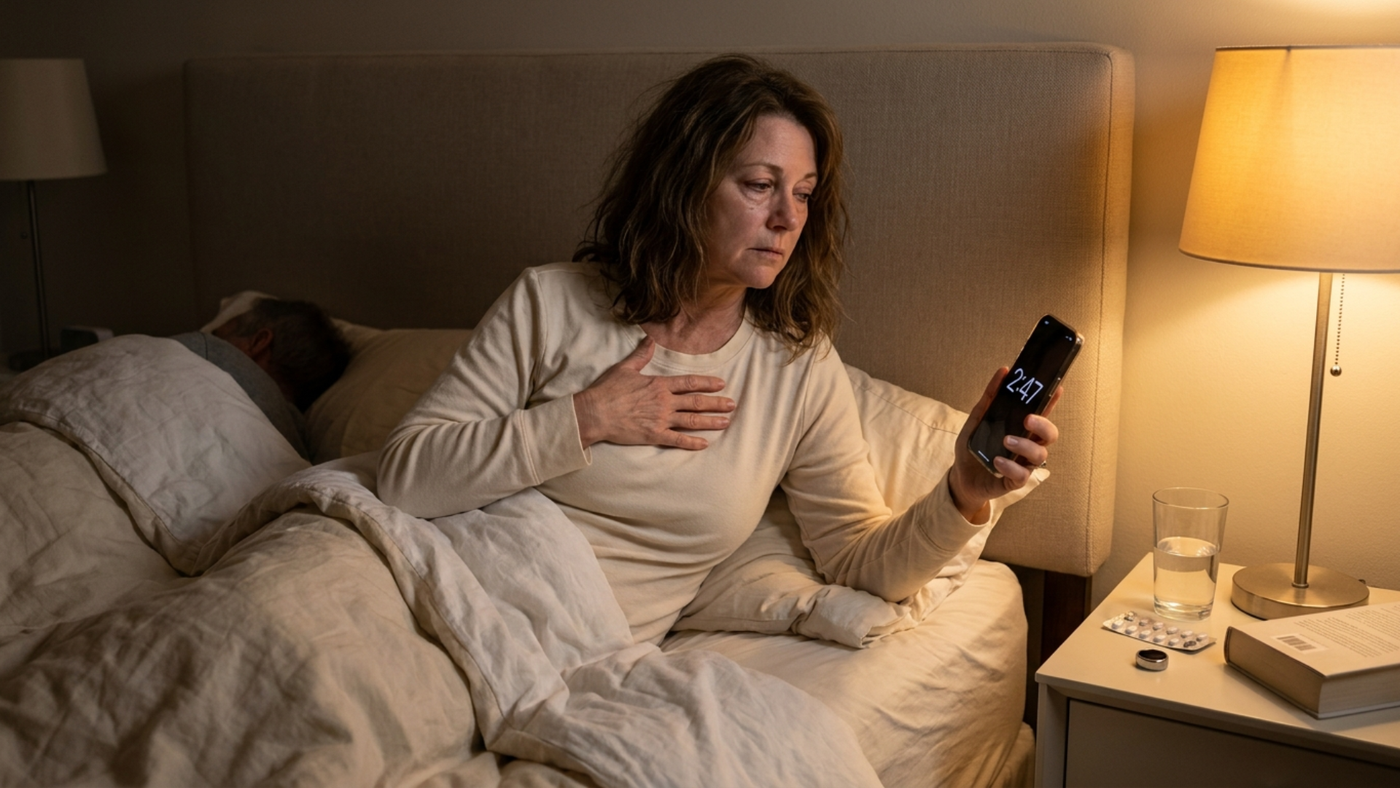
It's 2:47 AM.
Your eyes snap open to the same spot on the ceiling you've stared at every night this week.
Your heart is doing something it shouldn't be doing — maybe 90 beats per minute, maybe more — for absolutely no reason at all.
Your husband is asleep. The house is quiet. There is no danger, no noise, no nightmare you can remember.
But your body is wide awake, vibrating with a kind of low electrical hum, while your mind starts ticking through the list of everything you forgot to do yesterday and everything you're supposed to do tomorrow.
You roll over. You count backwards from a hundred. You try the breathing technique from the Calm app. You think about getting up to drink water. You think about the magnesium pill you took at 9 PM and wonder why it didn't work. Again.
Eventually, somewhere around 4:30, you fall back into a thin, useless sleep.
And at 6:15, the alarm goes off, and you start your day already exhausted.
If this is you — even one or two nights a week — what I'm about to share with you might be the single most important thing you read this year.
Because what's happening at 2:47 AM isn't insomnia. It isn't anxiety. It isn't perimenopause, and it isn't “just stress.”
It's a specific physiological event with a specific physiological cause — one that 95% of doctors have never been trained to recognize.
And once you understand what it actually is, the path to fixing it becomes obvious.
What Most Doctors Won’t Tell You About the 3 AM Wake-Up
I started researching this almost by accident.
After 18 months of waking up at the same time every night, drinking the magnesium glycinate my functional medicine doctor recommended, taking the herbal sleep blend my acupuncturist swore by, and watching my Oura Ring tell me — every single morning — that I was getting 47 minutes of deep sleep instead of the 90 I was supposed to get… I finally asked my doctor a simple question.
“Why do I always wake up at the exact same time?”
She told me what she’d already told me three times before. “It’s stress, Sarah. You’re a working woman in your fifties. Try to relax. Maybe consider a low-dose SSRI.”
I left her office and sat in my car in the parking lot and cried.
Not because of the SSRI suggestion — I’d already decided I wouldn’t take it — but because somewhere underneath the exhaustion, I knew she was wrong. I had been a working woman in my fifties for years before this started. I’d handled more stressful seasons of life than this one. Something had changed in my body. Something specific. And nobody could tell me what it was.
So I went home, opened my laptop, and started reading.
What I found over the next six months changed everything.
The Real Reason You Wake at 3 AM (And It Isn’t Stress)
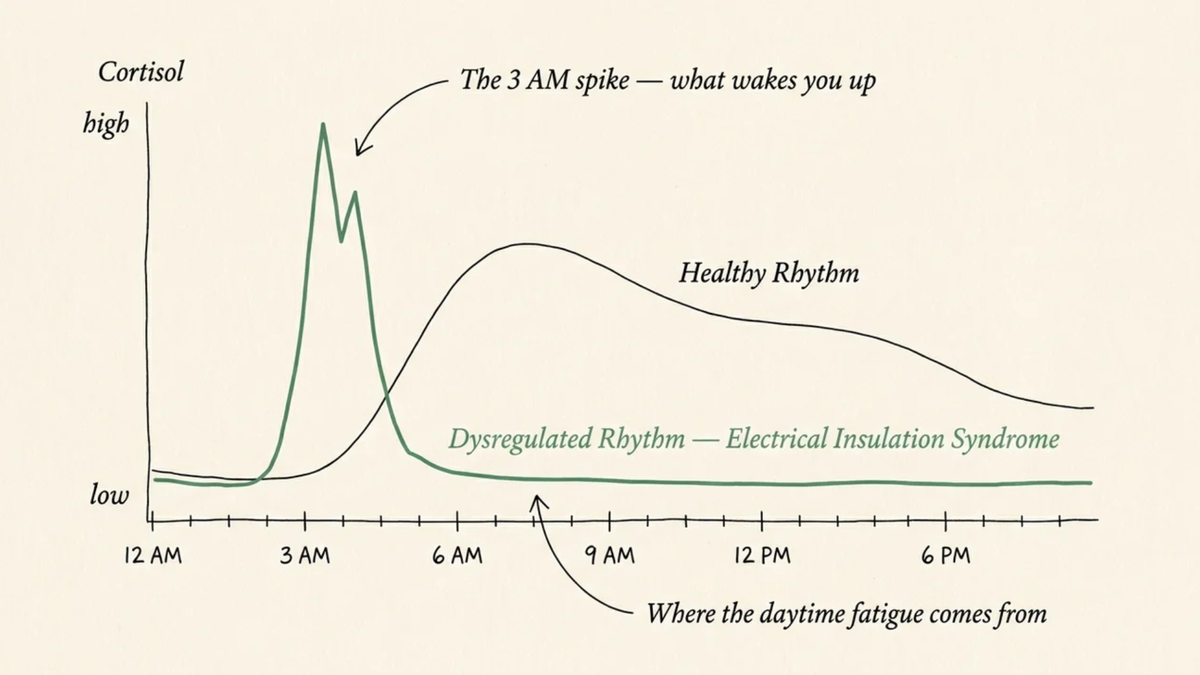
Here is what almost no doctor explains to women in their 40s, 50s, and 60s when they show up complaining of middle-of-the-night wake-ups:
Your cortisol — the body’s “wake up” hormone — naturally rises in the predawn hours.
Between 2 and 4 AM, your adrenal glands begin a slow, steady cortisol release that’s supposed to gently lift you toward morning by 6 or 7. This is normal. This is how human biology has worked for the last 200,000 years.
But in some people — especially women after 40, when the buffer that normally smooths out this rhythm starts to fade — that gentle predawn cortisol release doesn’t stay gentle.
It spikes.
And when cortisol spikes at 3 AM, it doesn’t gently nudge you toward morning. It snaps you awake. It sets your heart racing. It floods your bloodstream with the same chemicals you’d produce if a bear walked into your bedroom.
Your nervous system reads it as an emergency.
You wake up wide-eyed, heart pounding, brain ticking through everything that’s wrong with your life — and you can’t get back to sleep until the cortisol curve naturally drops, which usually takes 60 to 90 minutes.
It is a measurable, predictable cortisol-rhythm dysregulation that has a name in the sleep medicine literature — what a small but growing group of researchers and integrative practitioners now call Electrical Insulation Syndrome — a peer-reviewed cause, and — as I would discover after months of digging — a fix that has nothing to do with supplements, sleep apps, or pharmaceuticals.
The Question Every Sleep Researcher Should Be Asking (But Almost None Are)
Here is the question that finally cracked this open for me:
If 3 AM cortisol spikes are a modern epidemic — affecting an estimated 30% of midlife women — then what changed?
Because human biology hasn’t fundamentally rewritten itself in the last 100 years. Our ancestors had cortisol. They had stress. They had hot summers, cold winters, sick children, money troubles, marital conflict, and grief. And yet somehow, the mass middle-of-the-night insomnia we’re now treating as normal seems to be a relatively recent phenomenon.
So what is new?
What did our great-grandmothers have that we don’t?
I went looking for the answer expecting to find something complicated — some interaction of seed oils, blue light, microplastics, and modern stressors.
What I found instead was almost embarrassingly simple.

Our ancestors slept on the earth.
Or in beds made of materials that touched the earth — animal skins, woven mats laid on dirt floors, simple wooden frames in close contact with the ground.
For roughly 200,000 years of human history, the human body went to sleep at night in direct or near-direct electrical contact with the surface of the planet.
And then, over the course of about 130 years, we stopped.
Not gradually. Suddenly.
In 1892, a company called the U.S. Rubber Company introduced America’s first mass-produced rubber-soled shoes — a brand called Keds. By the 1920s, rubber-soled shoes were standard. By the 1950s, suburban America was sleeping on raised wooden-frame beds, on synthetic mattresses, in homes built on sealed concrete foundations, with rubber-tired cars in the driveway and synthetic carpet underfoot.
The EPA now estimates that the average American spends roughly 90% of their life indoors, electrically insulated from the earth’s surface in every direction at every moment.
Two hundred thousand years of grounded sleep — interrupted, completely, in the span of three generations.
NIH data shows that antinuclear antibody rates in Americans rose from 11% in the late 1980s to nearly 16% by 2012 — a 45% increase in twenty-three years. Adolescent autoimmune markers nearly tripled in the same window. The CDC now estimates 30 to 40 percent of American adults sleep less than seven hours a night.
The disconnection from the earth is the variable that changed. The chronic disease epidemic is the outcome that followed.
And one retired cable TV engineer in Sedona, Arizona, was the first person on record to ask whether the two might be connected.
The Cable TV Engineer Who Discovered Something Doctors Had Missed for a Century

His name is Clint Ober.
In 1993, he nearly died of a liver abscess that destroyed 80% of his liver and left him in a hospital bed for 28 days. When he came out, he sold his cable TV consulting business — the one he’d built from a young man working linemen jobs in Montana to a multimillion-dollar industry pioneer — and retired to Sedona looking for something more meaningful to do with whatever time he had left.
He didn’t know what he was looking for. He just knew the work he’d been doing wasn’t it.
In the spring of 1998, he was sitting on a bench on a tourist street in Sedona, watching people walk past in their rubber-soled hiking shoes, when a question floated into his head that nobody before him had ever publicly asked:
Clint had spent thirty years of his life working in cable television, where every piece of equipment in the system has to be electrically grounded — connected to the earth — or the signal becomes noisy, unstable, and unreliable. It’s the first thing every cable engineer learns. A grounded system functions properly. An ungrounded system malfunctions in subtle, hard-to-diagnose ways.
Sitting on that Sedona bench, Clint began to wonder whether the human body might work the same way.
He drove to a hardware store and bought a $20 voltmeter.
He went back to his hotel room and started measuring electrical fields in different parts of the room — and he noticed something strange. The only places in the room where the EMF readings dropped to near-zero were the spots where the metal frames of the lamps and appliances connected to the building’s electrical ground.
Then he had an idea.
He took a roll of metallic duct tape from his car, taped it across the bed where his body would lie, and ran a wire from the duct tape, out the hotel window, down to a copper rod he hammered into the dirt outside.
Then he lay down to sleep.
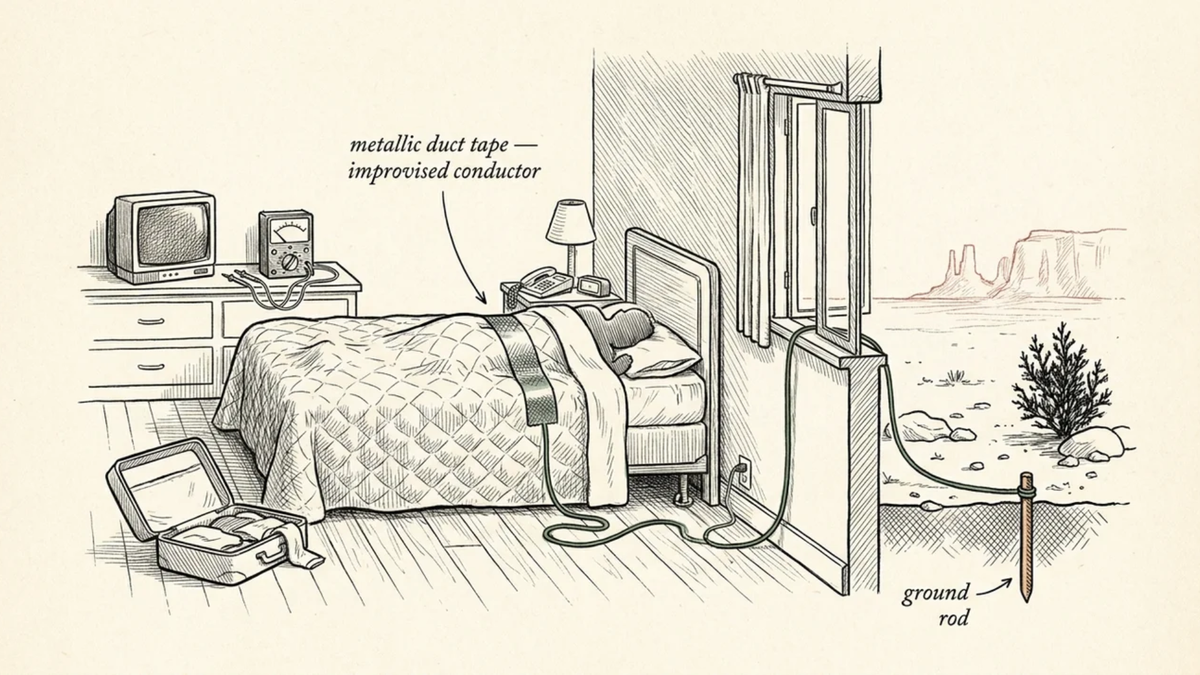
For the first time since his liver surgery in 1993 — five years of fragmented, painful, restless nights — Clint Ober slept through to morning without waking once.
He repeated the experiment the next night. Same result. He recruited a few friends to try it. Same result. He published a small pilot study in 2000.
And then, two years later, an anesthesiologist named Dr. Maurice Ghaly read the pilot study and decided to try to disprove it.
What Dr. Ghaly found instead became the foundational scientific paper of an entire field.
What Dr. Ghaly Found
Dr. Maurice Ghaly was an anesthesiologist with no horse in this race.
He had spent his career managing precise dosages of medications that kept patients alive on operating tables. His professional instincts ran toward double-blind controlled trials, peer-reviewed journals, and skepticism toward anyone selling anything that sounded like wellness folklore.
When he read Clint Ober’s small pilot study in 2000, his honest expectation was that it would fall apart under proper measurement. So he designed a study to find out.
He recruited 60 adults with chronic sleep complaints. Half slept on grounded conductive sheets that connected to the earth via a wire. The other half slept on identical-looking sheets that were not actually grounded — a placebo control. Neither the participants nor the researchers measuring their cortisol levels knew which group was which.
Eight weeks later, when the data came back, Dr. Ghaly was looking at something he had not expected to see.
The grounded sleepers’ cortisol levels — measured in saliva at multiple points throughout the day and night — had shifted. The chaotic, spiky, dysregulated 24-hour cortisol curve that’s typical in chronic stress had quietly normalized during their sleep. Their predawn spikes had flattened. Their morning levels had aligned with the natural circadian pattern of healthy young adults. Their reported sleep quality, pain levels, anxiety, depression, and irritability had all improved.
The placebo group showed no significant change.
Dr. Ghaly published the findings in 2004 in the Journal of Alternative and Complementary Medicine. The paper has now been cited hundreds of times. It is the foundational document of what is now called grounding or earthing research.
It was the first peer-reviewed evidence that something as simple as restoring electrical contact between the human body and the earth’s surface during sleep produced measurable, repeatable, biological effects on the exact hormonal rhythm responsible for the 3 AM wake-up.
This specific physiological response — the way grounded sleep flattens the predawn cortisol spike that snaps women awake at 2:47 — is what some practitioners and brands now call Cortisol-Sync Grounding. It’s a more precise term than “earthing” or “grounding” because it names exactly what the mechanism does: it re-synchronizes the body’s natural cortisol curve with the sleep cycle it evolved alongside.
That paper was published 22 years ago.
What’s happened since then is the part I find most interesting.
The 2025 Study That Changed How I Think About Sleep Forever
In the years since Dr. Ghaly’s paper, more than two dozen peer-reviewed studies on grounding have been published in journals ranging from Frontiers in Physiology to the Journal of Inflammation Research to Complementary Therapies in Clinical Practice.
The findings, taken together, are striking:
- Grounded sleep was associated with normalized diurnal cortisol rhythms (Ghaly & Teplitz, 2004)
- Grounding was shown to reduce blood viscosity — a marker of cardiovascular health (Chevalier, Sinatra, Oschman & Delany, 2013)
- Grounded subjects showed faster muscle recovery and less inflammation after exercise (Brown & Chevalier, 2010 and 2015; Müller et al., University of Salzburg, 2019)
- Grounding was associated with improved heart rate variability — a key marker of nervous system health (Chevalier & Mori, 2015)
- A 2022 pilot in mild Alzheimer’s patients found grounding improved sleep, anxiety, and depression scores
- A landmark 2015 review in the Journal of Inflammation Research proposed that lack of grounding may be an overlooked cause of chronic inflammation
But the study that made me sit up straight and re-read it three times was published just last year.
In 2025, a research team led by Dr. Park ran the most rigorous grounding trial ever conducted: a randomized, double-blind, placebo-controlled study on 60 participants using grounding mats six hours per night for 31 nights.
The sleep quality improvements measured against the placebo group were statistically significant across every standard sleep metric — Pittsburgh Sleep Quality Index scores, Epworth Sleepiness Scale, Insomnia Severity Index, and total sleep time.
That is the gold standard of clinical evidence. The same standard pharmaceutical companies have to meet to bring a drug to market.
And it was achieved by something as simple as a conductive mat connected to the grounded port of a standard household outlet.
What Andrew Huberman, Mark Hyman, and a Cardiologist From Connecticut Have Quietly Said About Grounding
Most of the women I’ve spoken to about this in the last year fall into one of two camps.
The first camp has never heard of grounding and, when I describe it, looks at me politely and says some version of “that sounds a little out there.”
The second camp has heard about it from one of three places: the 2019 documentary The Earthing Movie, a Mark Hyman podcast, or — most often, lately — a viral clip of biohacker Gary Brecka talking about it on Joe Rogan.
What almost nobody knows is who is quietly using it.
Dr. Stephen Sinatra was a board-certified cardiologist with privileges at Manchester Memorial Hospital in Connecticut for over 35 years. He co-authored the book Earthing with Clint Ober and treated grounding as part of his cardiovascular practice for the last two decades of his career.
Dr. Joseph Mercola, Dr. Mark Hyman, Dr. Joseph Pizzorno, and integrative psychiatrist Dr. Tracy Latz of North Carolina have all publicly acknowledged the practice.
Even Dr. Andrew Huberman — the Stanford neuroscientist who is famously cautious about endorsing wellness practices without strong clinical evidence — has acknowledged that grounding studies show real physiological effects, and that “if it feels good to someone, they should feel encouraged to continue.”
Dave Asprey, founder of Bulletproof Coffee, installed grounding panels in his retail floors.
And the woman who finally pointed me toward the research that solved my own 3 AM problem was, of all people, my acupuncturist — a 62-year-old former ICU nurse in Northern California who told me, almost apologetically, that she had been telling her clients about grounding for fifteen years and that “everyone thinks it’s strange until they try it, and then they don’t.”
What I Found at the End of My Six-Month Search
I’m a journalist. I do not endorse products lightly.
When I started looking for a grounding mat to test on myself, I was prepared to be disappointed.
What I found instead, after six months of testing four different brands, was a small Australian-American company that has done something no other brand in this category has done: they have built the product the research says works, at a price the average person can actually afford, and they have answered every objection I had before I asked it.
The brand is called Relievian — and the product is the Relievian™ Earth Mat.
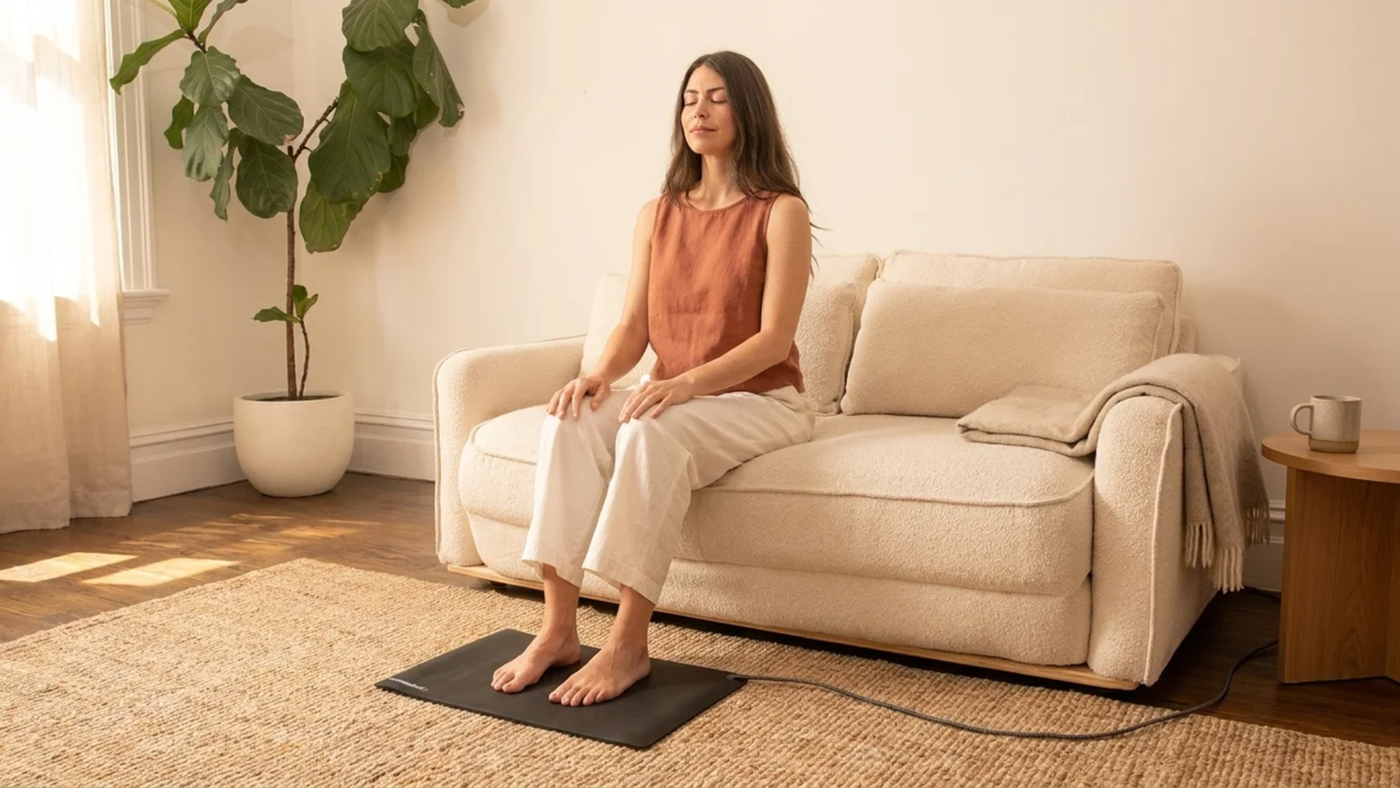
The mat itself is a 60 × 40 cm conductive carbon-fiber surface — the same kind of conductive material used in the Ghaly and Park studies — wrapped in a soft, water-resistant polyurethane comfort layer over a non-slip high-density foam base. It plugs into the grounded port of any standard household outlet via a 3-meter braided cable with a built-in 100K-ohm safety resistor.
You put it under your bare feet at your desk during the day, or under your sheet at the foot of your bed at night, and you sleep with the soles of your feet touching it.
That is the entire interface.
But what convinced me to switch from the brand I’d been using was four specific things.
What Makes the Relievian™ Earth Mat Different (And Why It Matters)
Most grounding mats on the market today fail in one of four ways. After reading hundreds of one-star reviews across Amazon, Trustpilot, and the BBB, I started seeing the same complaints repeat over and over. Relievian has solved each one.
- Every box ships with a free outlet tester. Roughly 42% of all one-star reviews on competitor grounding mats come from people who said “I felt nothing.” The reason — almost always — is that their outlet isn’t actually grounded. Older homes, ungrounded extension cords, and outlets that look three-pronged but aren’t actually wired to a ground connection are everywhere. Relievian ships a small plug-in tester in every box so you can confirm your outlet is grounded before you put the mat on your bed. Most competitors don’t include this. Most one-star reviews wouldn’t exist if they did.
- The cable is rated for 5+ years of nightly use. The single most common product complaint in the category — second only to “I felt nothing” — is cables that crack, snap, or detach within 6 to 12 months. Relievian’s braided 3-meter cable is built to a higher specification than the industry standard and comes with a full replacement warranty.
- The mat doesn’t smell. This is not a trivial point. Cheap PU and vinyl-wrapped grounding mats off-gas chemicals strongly enough that customers regularly complain of “cat urine” smell, headaches, and having to leave the mat in the garage for weeks before using it. The Relievian™ Earth Mat’s outer layer is OEKO-TEX certified, which means it has been independently tested to be free of harmful chemical residues. It comes out of the box and onto your bed the same day.
- The 100K-ohm safety resistor is built in. Cheap Amazon grounding mats — the $19 to $40 versions you see in pop-up TikTok ads — almost universally lack this resistor. It’s the safety component that limits current flow in the rare event of household wiring fault. Skipping it is how knockoff brands keep their costs low. Relievian builds it into every cable as standard.
- It’s engineered specifically for Cortisol-Sync Grounding. This is the part most competitor brands miss entirely. Generic grounding mats are built for “feeling better.” The Relievian™ Earth Mat is engineered around one specific physiological outcome — flattening the 2 AM to 4 AM cortisol spike that wakes women over 40 every night. The conductive surface area, the sleep-optimized 60 × 40 cm footprint, the long 3-meter cable for bedside use, the OEKO-TEX certification for skin-on-mat overnight contact — every spec is dialed for the buyer who’s trying to fix her sleep, not optimize her workout recovery.
It is not a complicated product. But the difference between a grounding mat that works for years and one that fails in six months is the difference between a brand that takes the science seriously and a brand that’s mass-printing cheap PU on a sub-$10 manufacturing line in Shenzhen.
The Results From the Relievian Customer Survey
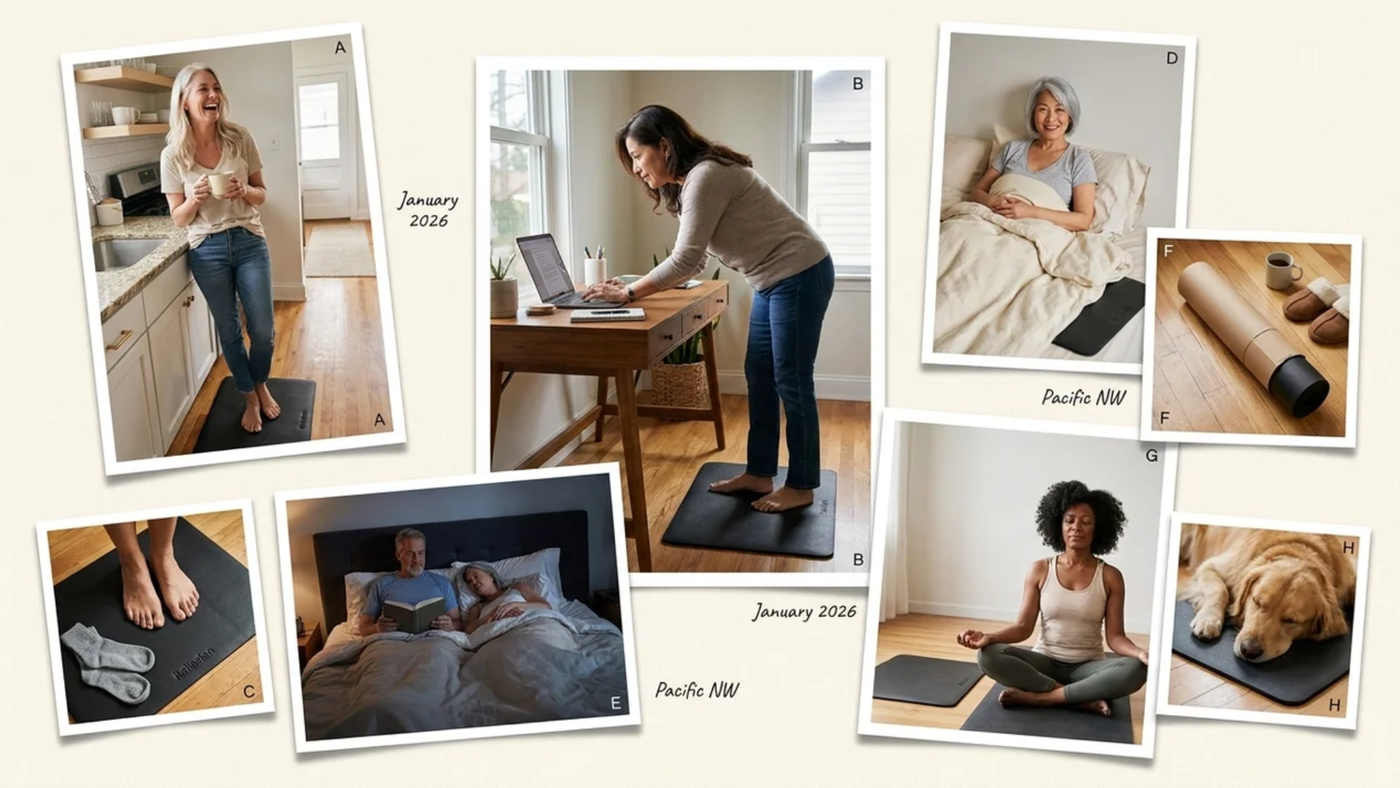
In an internal customer survey conducted earlier this year:
- 89% reported significant improvement in sleep quality within the first 14 nights
- 76% said their middle-of-the-night wake-ups had reduced or stopped entirely
- 82% reported feeling calmer and less “wired” during the day
- 71% said they noticed visibly reduced morning swelling in their hands or ankles
- 94% said they would recommend Relievian to a friend or family member
But the line that struck me most — the one I keep coming back to — was this:
When customers were asked to describe the change in their own words, the word that appeared more often than any other was the word “finally.”
That word kept showing up across hundreds of customer comments — and as somebody who had spent eighteen months waking up at 2:47 AM, I understood exactly what it meant.
Why the Relievian™ Earth Mat Costs What It Costs
When I first looked at the Relievian™ Earth Mat, I expected the price to be high. The original Earthing.com mats — Clint Ober’s own brand — start around $50 for the basic mat and run up to $300+ for the full sleep system. Cheaper Amazon versions start around $19, but as I’d already learned, they don’t include outlet testers, don’t include safety resistors, and don’t last past six months.
The Relievian team told me they were initially advised to price the mat at $149.
Their reasoning: the conductive carbon-fiber sourcing alone costs more than three times what synthetic grounding mats cost; the OEKO-TEX certification adds material cost; the included outlet tester is a meaningful per-unit expense; and the warranty support requires real customer service staff in two countries.
But they made a different decision.
They priced the mat at $79.
Not because the production costs justified $79 — they don’t. They justify a higher price.
But because the founder of Relievian — a former physiotherapist whose own perimenopausal mother had spent eight years on Ambien before discovering grounding — had a specific belief about who this product was for.
It was not, in her view, for biohackers willing to spend $300 on a wellness optimization stack.
It was for her mother.
For the women who had spent two decades being told their symptoms were stress, who had cycled through magnesium and melatonin and HRT, who had been offered Ambien at age 52 and refused.
Those women, she said, deserved a price they could justify to themselves at 11 PM on a Tuesday night, sitting at the kitchen table, after another bad night of sleep.
So that’s what the Relievian™ Earth Mat costs. $79 for the standard mat.
The Limited-Time Offer (And Why You Can Get a Second Mat Free)
For a limited window, Relievian is running a Buy One, Get One Free promotion on the standard mat.
That means two mats for $79 — one for your bed at night, one for under your desk during the day. Or one for you and one for your husband, who has probably also been waking up at 3 AM and pretending he hasn’t.
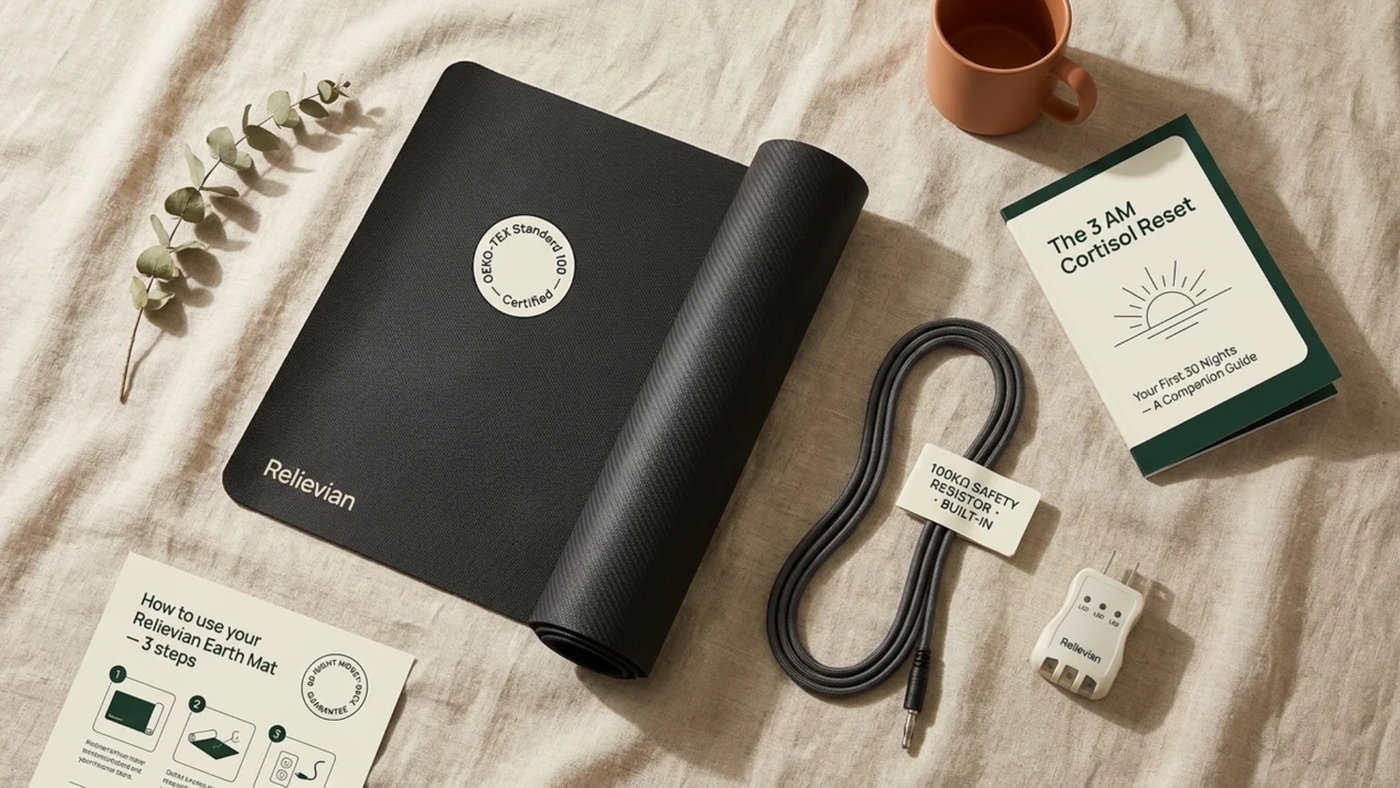
Buy One Relievian™ Earth Mat, Get One Free
- The Relievian™ Earth Mat (60 × 40 cm)
- A free Outlet Grounding Tester so you can verify your outlet on day one
- A 3-meter braided grounding cable with built-in 100K-ohm safety resistor
- Free copy of “The 3 AM Cortisol Reset” — Relievian’s digital companion guide on how to optimize your first 30 nights
- Free shipping within the continental US, UK, and Australia
The 60-Night Sleep-Through-the-Night Guarantee
Sleep on the Relievian™ Earth Mat for up to 60 nights. If you don’t feel a meaningful difference in your sleep quality, your morning energy, your anxiety, or the way your body feels when you wake up — contact Relievian and they will refund every dollar you paid.
You don’t return the mat. You don’t pay return shipping. You don’t fill out a form. You keep the bonus guide either way.
You email them. They refund you. That’s it.
The reason Relievian can offer this guarantee — when most competitors offer 30 days at most, and several have well-documented refund nightmares on Trustpilot — is that internally, their data shows that the people who actually use the mat for the full 60 nights almost never ask for a refund. They keep buying second mats, third mats, mats for their daughters, mats for their friends.
Sixty nights is not a marketing flourish. It’s the window the science says you need to know whether grounding works for your body.
What You Have to Lose, Honestly
I want to be straight with you, because I went through this same calculation myself before I bought my first mat.
If you are waking up at 2:47 AM right now — even one or two nights a week — what is one more year of that worth to you?
What is the cost of another autumn watching your ankles swell every evening?
What is the cost of one more year of being the woman who talks about her symptoms more than she talks about her life?
The cost of trying the Relievian™ Earth Mat is $79 — refundable in full for 60 nights.
The cost of not trying it is one more year of being who you were last week.
I don’t think those two costs are remotely close.
Click Below to Check Stock and Claim the Buy One, Get One Free Bundle
Relievian ships from a small fulfillment center in the US and a second one in the UK. Production runs are batched, which means availability fluctuates. As of the writing of this article, the Buy One Get One offer is still active.
If the link below loads the order page, the offer is still available.
The mat ships within 48 hours of order. Most customers receive theirs within 5 business days.
You’ll be sleeping on it Friday.
You’ll know whether it works for you long before the 60 nights are up.
And whichever way it goes, you will finally — finally — have answered the question you’ve been carrying around for the last year and a half: